The Evolution of Personalization: From Smart Frames to Chameleon Cars
Hasta la vista, paint. Hello, skin.
Imagine waking up and, with a simple voice command, turning the digital frame in your living room into a custom work of art — maybe a family photo stylized like a Renaissance painting, or a landscape to match your morning mood. This isn’t sci-fi; at CES 2026, gadgets like these were showcased with generative AI running locally, allowing you to create custom visuals effortlessly. But what if this magic extended beyond your home to something as essential as your car? Let’s take a ride through history to glimpse a future where vehicles are no longer stuck with a fixed color, but adapt to your lifestyle like a smart wardrobe.
Think about the evolution of the automobile: when the first cars were built in the 19th century, like the 1886 Benz Patent-Motorwagen, no one imagined they would eventually feature things we take for granted today, like seatbelts (invented in 1959) or rearview mirrors (popularized in the 1910s). These advances turned the car from a rudimentary machine into a safe, functional companion. Now, we are on the verge of another revolution: visual customization driven by AI, which could redefine how we express ourselves on the road.
Remember Henry Ford, the visionary behind the Model T? He famously quipped, “Any customer can have a car painted any color that he wants so long as it is black.” Back then, industrial efficiency ruled the day, limiting options to speed up production. Over time, colors diversified—only to settle back into dominant shades like black, white, and gray, which make up most global sales today. This visual sameness is like a sea of blue jeans on the street: versatile, sure, but predictable. Silver is practical because it hides the dirt; white makes the car look bigger (and is cheaper to produce, appealing to companies that wrap them with logos); and black? Ah, the classic black—the automotive equivalent of a wardrobe staple that works for any occasion, conveying effortless sophistication.
“Any customer can have a car painted any color that he wants so long as it is black.”
Henry Ford
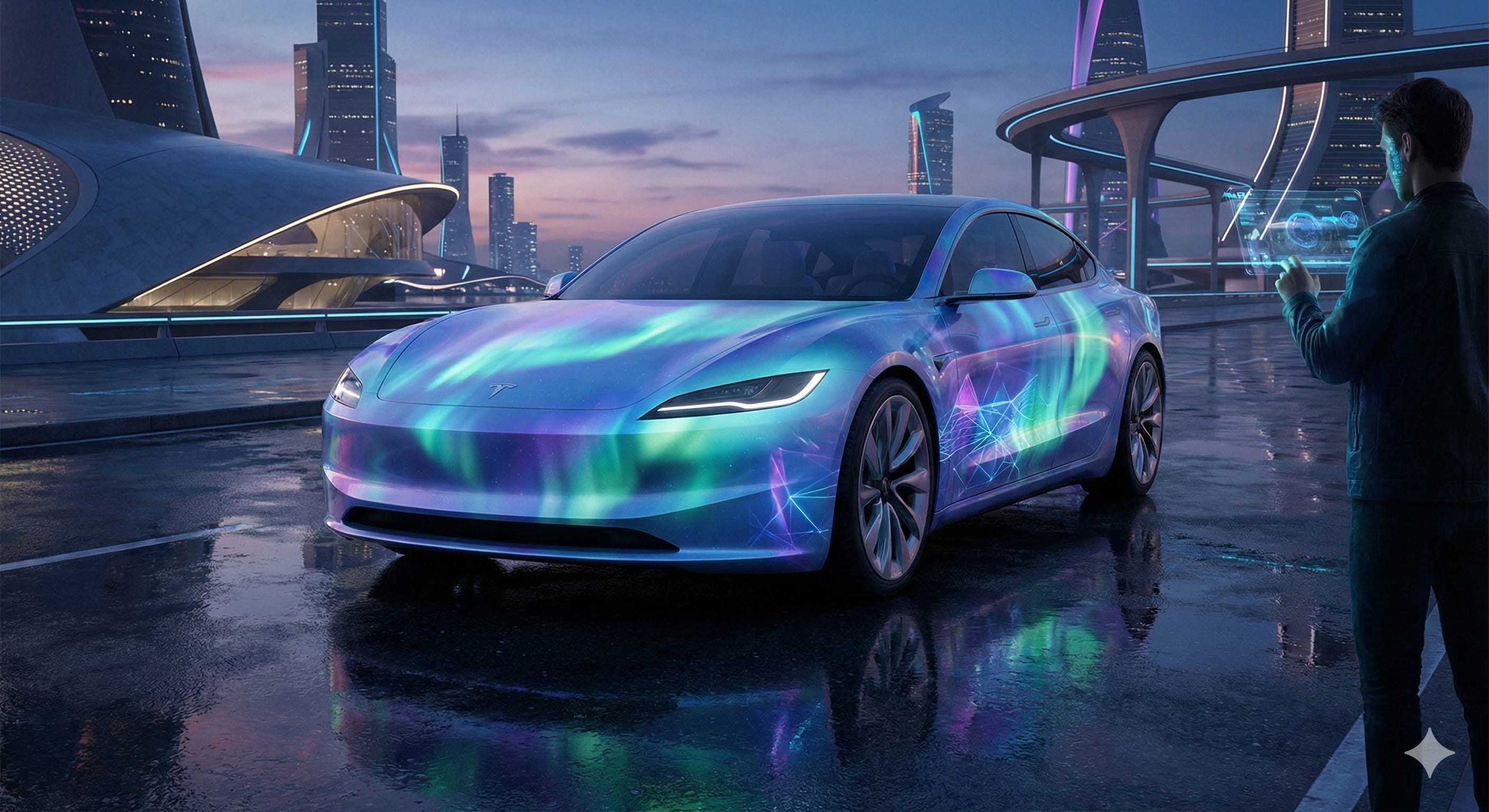
But here’s a thought: no matter how much you love your current car color, what if your mood changed? What if one day you wanted something vibrant to celebrate a personal victory, and the next, something discreet for a big meeting? This rigid limit—picking one color and being locked into it for years—feels increasingly outdated in a world where everything is customizable. That’s where generative AI steps in, bridging the present and an exciting future: imagine vehicles equipped with smart skins that, via a smartphone app, change their exterior on demand. We aren’t talking about temporary stickers, but immersive, instant customization.
Picture this: on match day, your car decks itself out in your national team’s colors, flashing in sync with the crowd’s energy. Or imagine celebrating a global holiday: your vehicle could turn emerald green for St. Patrick’s Day, or display spooky, shifting shadows for Halloween. Companies could take this to another level: delivery fleets adapting to seasonal campaigns, like a festive red for Christmas or earthy tones for Earth Day. This isn’t entirely new—think of city buses with dynamic ad screens. But with AI, we level up to total immersion, where the vehicle becomes an extension of your identity, not just a mode of transport.
Of course, every innovation brings challenges, especially regarding safety. Imagine police chasing a stolen vehicle that, like a chameleon, blends into the cityscape by shifting colors and patterns. Concerns like this will demand smart solutions: perhaps customizations protected by biometrics or linked to tracking systems, ensuring only the rightful owner can “change its skin.” Regulators and manufacturers will have to balance creativity with responsibility, but the potential to make roads safer (think automatic night-visibility modes) is immense.
This vision aligns perfectly with the trend toward EVs and the “smartphone-ification” of mobility. Modern cars are already packed with tech — touchscreens, voice assistants, over-the-air updates — turning them into smartphones on wheels. It’s no coincidence that giants like Apple and Xiaomi are betting big on vehicle manufacturing: both worlds deal with intuitive interfaces, efficient batteries, and connected ecosystems. A phone manages your digital life; a smart electric car manages your mobility, with AI optimizing routes, consumption, and now, appearance. It makes perfect sense: just as we update apps for new features, we’ll be able to “update” the car’s look to suit new moods.
How about you? Have you stopped to imagine your car transforming at the touch of a button, reflecting not just who you are, but how you feel that day? This fusion of AI with daily life isn’t just about convenience—it’s about unlocking imagination. Stay tuned for more glimpses of this future speeding our way. What would you personalize first? Share it in the comments!